
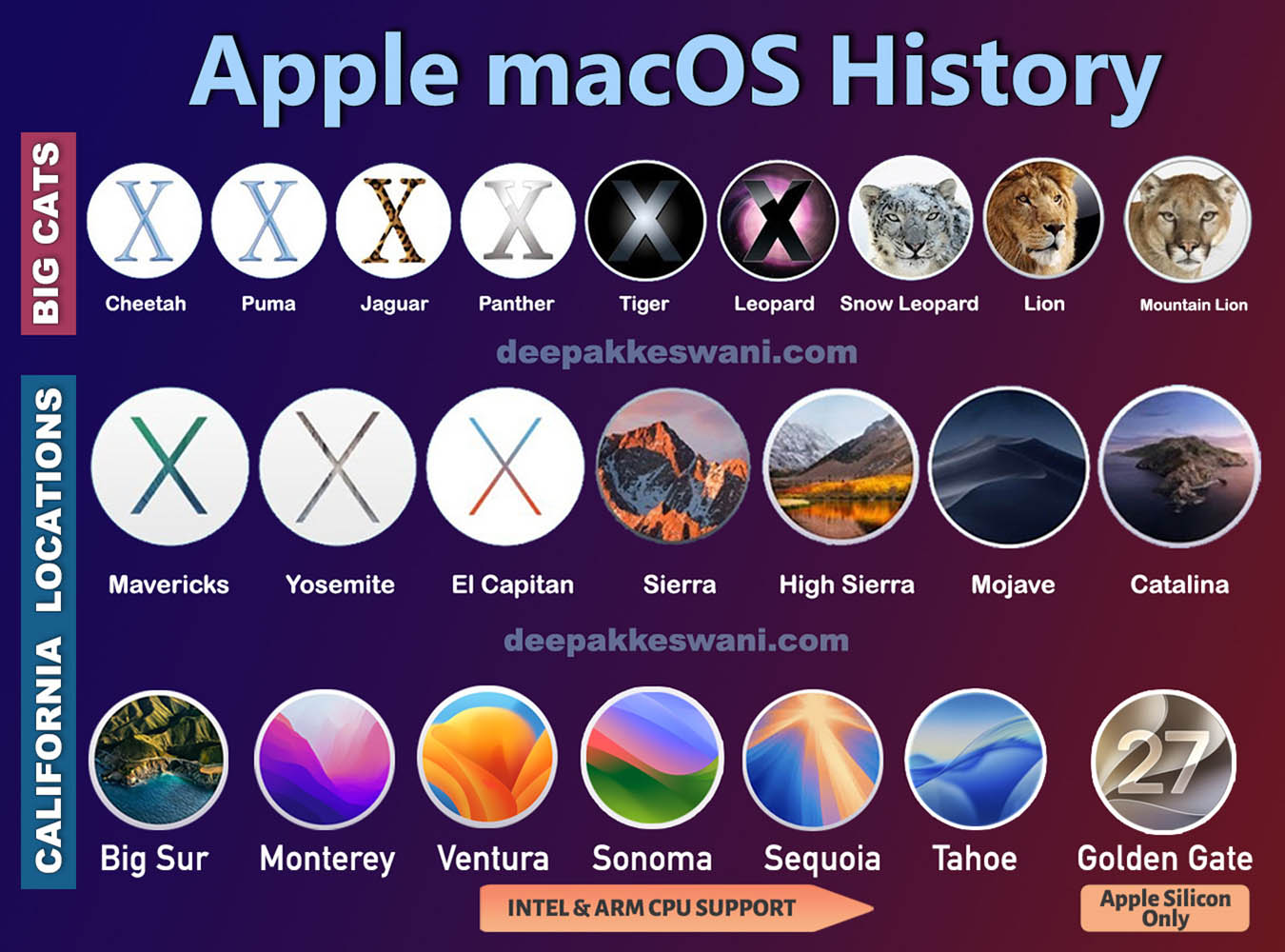
Apple always wanted to make the hardware and software in USA. As there were challenges in returning the hardware manufacturing to USA, they started the convention of marking hardware as designed in California, USA. To extend and highlight the innovation team sitting in Cupertino, they came up with this new trend of naming Mac OS version with the famous locations of California State. It promotes the California State Tourism as well as relates the team sitting in USA.
Mac OS Releases named after locations of California State
- MacOS 27: Golden Gate – June 8, 2026 (64 bit Apple Silicon only)
- MacOS 26: Tahoe – June 9, 2025 (64 bit Intel & ARM)
- MacOS 15: Sequoia – June 10, 2024 (64 bit Intel & ARM)
- MacOS 14: Sonoma – June 5, 2023 (64 bit Intel & ARM)
- MacOS 13: Ventura – 24-Oct-2022 (64 bit Intel & ARM)
- MacOS 12: Monterey – 25-Oct-2021 (64 bit Intel & ARM)
- MacOS 11: Big Sur – 12-Nov- 2020 (64 bit Intel & ARM)
- MacOS 10.15: Catalina – 7-Oct-2019 (64 bit Intel only)
- MacOS 10.14: Mojave- 24-Sep-2018 (32/64 bit Intel only)
- MacOS 10.13: High Sierra- 25-Sep-2017 (32/64 bit Intel only)
- MacOS 10.12: Sierra- 20-Sep-2016 (32/64 bit Intel only)
- OS X 10.11: El Capitan- 30-Sep-2015 (32/64 bit Intel only)
- OS X 10.10: Yosemite-16-Oct-2014 (32/64 bit Intel only)
- OS X 10.9 Mavericks-22-Oct-2013 (32/64 bit Intel only)
Mac OS releases named after Big Cats
- OS X 10.8 Mountain Lion- 25-Jul-2012 (32/64 bit Intel only)
- OS X 10.7 Lion- 20-Jul-2011 (32/64 bit Intel only)
- OS X 10.6 Snow Leopard- 28-Aug-2009 (32/64 bit Intel and 32 bit PowerPC)
- OS X 10.5 Leopard- 26-Oct-2007 (32/64 bit PowerPC and Intel)
- OS X 10.4 Tiger – 29-Apri-2005 (32/64 bit PowerPC and Intel)
- OS X 10.3 Panther -24-Oct-2003 (32/64 bit PowerPC)
- OS X 10.2 Jaguar – 24-Aug-2002 (32/64 bit PowerPC)
- OS X 10.1 Puma – 25-Sep-2001 (32 bit PowerPC)
- OS X 10.0 Cheetah – 24-Mar-2000 (32 bit PowerPC)
Old small image representing the Apple macOS History from Cheetah till Monterey

Brief history of Apple’s Mac operating systems
1. Macintosh System Software (1984-1987)
- Introduced with the original Macintosh 128k
- Simple, graphical user interface
2. System 1-6 (1985-1991)
System 7 (1991): Major update with multitasking
3. System 7-7.6 (1991-1997)
- System 7.5 (1994): Added TCP/IP support
- System 7.6 (1997): Last classic Mac OS release
4. Mac OS 8-9 (1997-2001)
- Mac OS 8 (1997): Improved performance and multitasking
- Mac OS 9 (1999): Added multiple user support
5. Mac OS X (2001-2012)
- Mac OS X 10.0 Cheetah (2001): Unix-based, modern architecture
- 10.1 Puma (2001), 10.2 Jaguar (2002), 10.3 Panther (2003)
- 10.4 Tiger (2005), 10.5 Leopard (2007), 10.6 Snow Leopard (2009)
- 10.7 Lion (2011), 10.8 Mountain Lion (2012)
6. OS X (2013-2015)
10.9 Mavericks (2013), 10.10 Yosemite (2014), 10.11 El Capitan (2015)
7. macOS (2016-present)
- 10.12 Sierra (2016), 10.13 High Sierra (2017), 10.14 Mojave (2018)
- 10.15 Catalina (2019), 11 Big Sur (2020), 12 Monterey (2021)
- 13 Ventura (2022), 14 Sonoma (2023)
- 15 Sequoia (2024) comes with Apple Intelligence
History of Apple Mac hardware
Early Years (1984-1990)
- Macintosh 128k (1984): 8 MHz 68000 processor, 128 KB RAM
- Macintosh 512k (1985): 8 MHz 68000 processor, 512 KB RAM
- Macintosh Plus (1986): 8 MHz 68000 processor, 1 MB RAM
- Macintosh SE (1987): 8 MHz 68000 processor, 1 MB RAM, internal floppy
- Macintosh II (1987): 16 MHz 68020 processor, 1 MB RAM, expandable
PowerBook and Quadra (1990-1995)
- Macintosh Portable (1989): 16 MHz 68000 processor, 1 MB RAM, portable
- PowerBook 100 (1991): 16 MHz 68000 processor, 2 MB RAM, laptop
- Quadra 700 (1991): 25 MHz 68040 processor, 4 MB RAM, desktop
- PowerBook Duo (1992): 25 MHz 68030 processor, 4 MB RAM, subnotebook
PowerPC Era (1994-2005)
- Power Macintosh 6100 (1994): 66 MHz PowerPC 601 processor, 4 MB RAM
- iMac (1998): 233 MHz PowerPC G3 processor, 32 MB RAM, all-in-one
- PowerBook G3 (1997): 266 MHz PowerPC G3 processor, 32 MB RAM, laptop
- Power Mac G4 (1999): 400 MHz PowerPC G4 processor, 64 MB RAM, desktop
- Power Mac G5 (2003): 1.6 GHz PowerPC G5 processor, 256 MB RAM, desktop
Intel Transition (2005-2012)
- MacBook Pro (2006): 1.83 GHz Intel Core Duo processor, 512 MB RAM, laptop
- MacBook Air (2008): 1.6 GHz Intel Core 2 Duo processor, 2 GB RAM, ultraportable
- iMac (2009): 2.66 GHz Intel Core i5 processor, 4 GB RAM, all-in-one
- Mac Pro (2009): 2.66 GHz Intel Xeon processor, 3 GB RAM, workstation
- MacBook Pro Retina (2012): 2.7 GHz Intel Core i7 processor, 8 GB RAM, laptop
Modern Era (2013-present)
- MacBook Air (2013): 1.3 GHz Intel Core i5 processor, 4 GB RAM, ultraportable
- iMac Retina (2014): 3.5 GHz Intel Core i5 processor, 8 GB RAM, all-in-one
- MacBook (2015): 1.1 GHz Intel Core M processor, 8 GB RAM, laptop
- MacBook Pro Touch Bar (2016): 2.9 GHz Intel Core i7 processor, 16 GB RAM, laptop
- iMac Pro (2017): 2.3 GHz Intel Xeon processor, 32 GB RAM, workstation
- MacBook Air (2020): 1.1 GHz Intel Core i5 processor, 8 GB RAM, ultraportable
- M1 MacBook Air (2020): Apple M1 chip, 8 GB RAM, ultraportable
- M2 MacBook Air (2022): Apple M2 chip, 8 GB RAM, ultraportable
- M3
- M4
- M5 – iPad Pro, MacBook Pro, Vision Pro, Macbook Air (2025)
- M6 – Mac Mini (2026)
Apple Silicon Transition (2020-present)
- M1 Mac Mini (2020): Apple M1 chip, 8 GB RAM, desktop
- M1 MacBook Pro (2020): Apple M1 chip, 8 GB RAM, laptop
- M1 iMac (2021): Apple M1 chip, 8 GB RAM, all-in-one
- M2 MacBook Pro (2022): Apple M2 chip, 8 GB RAM, laptop
- M2 Mac Mini (2023): Apple M2 chip, 8 GB RAM, desktop
- M3 iMac (2023)
- M4 Mac Book Air (2025)
- M4 MacBook Pro 14 inch (2024)
- M4 MacBook Pro 16 inch (2024)
- M4 iMac (2024)
- M5 – MacBook Pro (October 15, 2025)
- M6 – Mac Mini (August 25. 2026)